

From Bread to Bottle
By Rose Kelly
25 September 2026
Editorial
In a former scrap-metal yard in Dunedin, New Zealand, Jenny McDonald and Sue Stockwell are turning yesterday’s bread into award-winning spirits. Rose Kelly heads across the ditch to unearth their story.
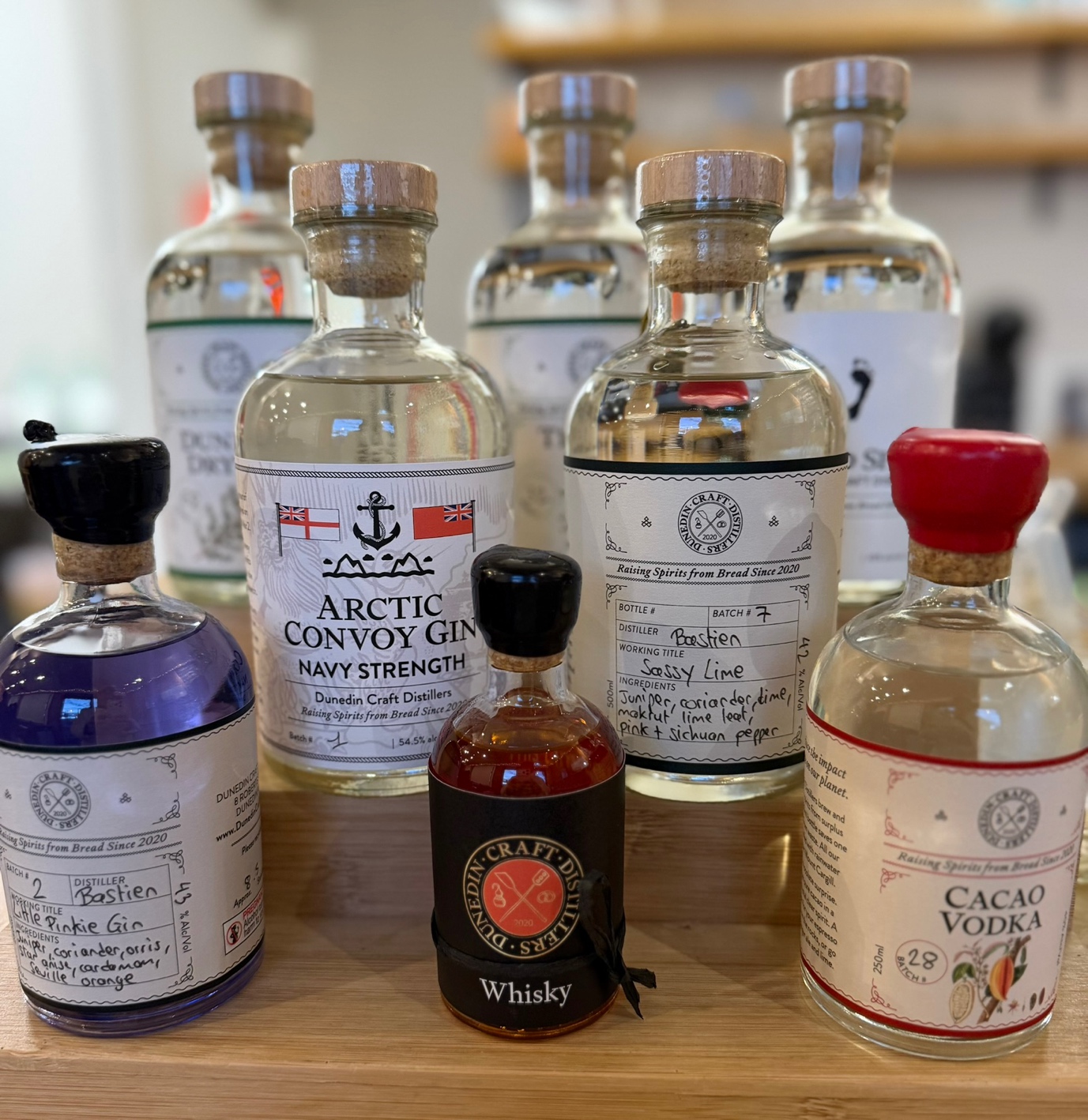
A selection of the gins, vodkas and whiskey from Dunedin Craft Distillers. Image Rose Kelly
It started, as many good ideas do, over coffee. In 2019, Jenny McDonald found herself in a conversation about the extraordinary amount of perfectly edible bakery product being sent to landfill. Bread. Rolls. Pastries. Buns. Food that had already consumed land, water, energy and labour to produce, only to become waste.
For McDonald, who has a scientific background, and a retired Doctor, there was something particularly maddening about it. Bread, after all, is largely starch and carbohydrate.
Starch can become sugar. Sugar can become alcohol. And that thought sent her down what she describes as a rabbit hole.
The result is Dunedin Craft Distillers, the small, unconventional distillery McDonald now runs with Sue Stockwell, where surplus bakery products are transformed into premium gin, vodka, liqueurs and, perhaps most intriguingly, whisky.
It is an elegant solution to an inelegant problem.
Rather than beginning with the question of how to make another boutique gin, McDonald and Stockwell began with waste. Research into supermarket food waste led them to estimate that roughly 70 to 80 tonnes of bakery products were being discarded in Dunedin, New Zealand each year. Each loaf also carries an environmental cost long before it reaches the bin, from growing and processing wheat to manufacturing, transport and distribution.
So, the pair asked a deceptively simple question: could we make alcohol from bread?
The answer was yes. But “yes” turned out to be considerably more complicated than it sounded.
The alchemy of leftovers
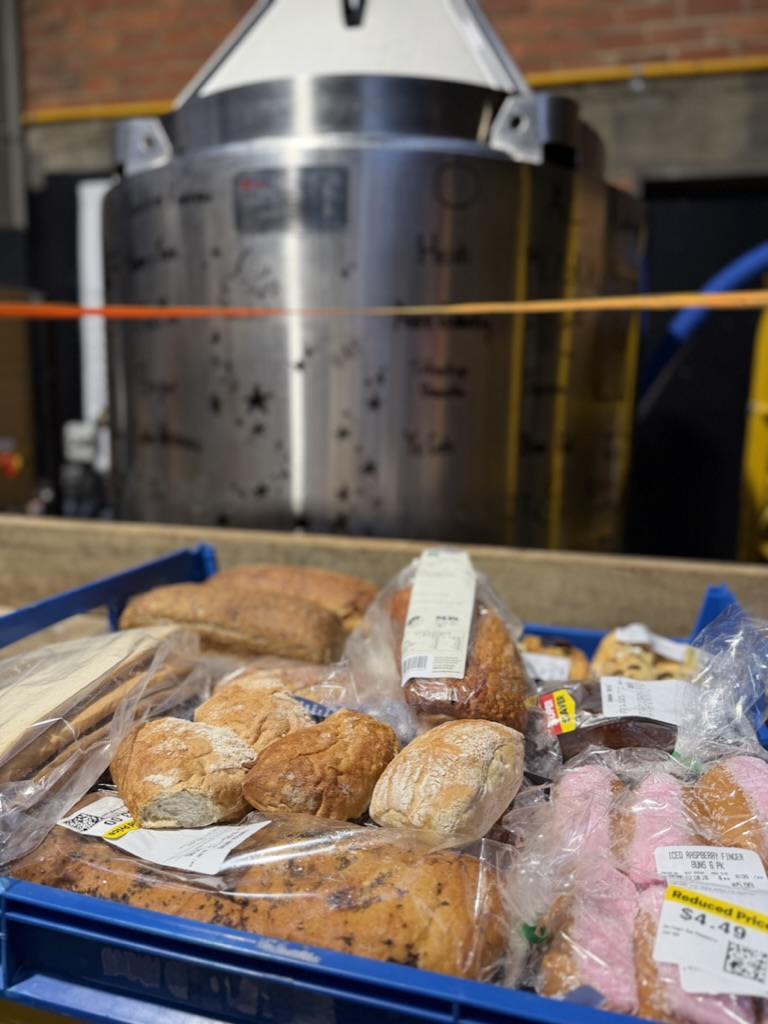
The food rescue products that become the mash for the distillery. Image Rose Kelly
Today, unwanted bakery products arrive at the distillery from food-rescue organisation Kiwi Harvest and other local suppliers. Importantly, this is food that cannot otherwise be redistributed for people to eat.
The process is surprisingly physical. Around 200 kilograms of rescued bakery product can go into a batch, mixed with water and malt before being heated into a thick mash. The starches and carbohydrates are converted into fermentable sugars, the solids are filtered out and yeast is added to the resulting liquid. Over about five days, fermentation converts those sugars into alcohol. Then comes distillation.
The fermented bread wash is pumped into the distillery's 500-litre reflux still, where it is distilled into a high-strength semi-neutral spirit. Rather than importing or purchasing a commercial base alcohol, common practice among gin producers, Dunedin Craft Distillers makes its spirit from scratch. That distinction matters.
The bread isn't a sustainability flourish added to the story after the fact. It is the raw material.
The resulting spirit can then head in several directions: gin infused with botanicals, vodka, liqueurs and digestifs, seasonal creations such as mulled gin, or whisky left to slowly develop in oak.
And McDonald is particularly interested in what is happening inside those whisky casks.
“I’m getting quite excited about the whisky we are producing,” she says. “It has a lovely layered vanilla effect. It’s accentuated as it sits in the cask.”
There is something wonderfully subversive about it: unwanted bread, destined for a rubbish truck, emerging years later as a complex whisky with layers of vanilla.
Nothing wasted
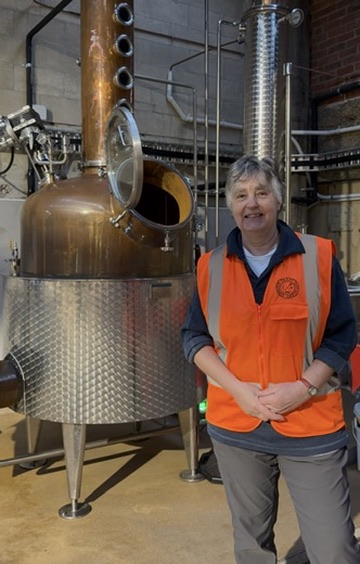
Dr Jenny McDonald, co-founder of Dunedin Craft Distillers. Image Rose Kelly
The circularity doesn't end when the alcohol leaves the mash.
Once the sugars have been extracted, the spent solids still have nutritional value. Rather than throwing them away, the distillery passes the mash solids to nearby local dairy company Holy Cow, where they are fed to its small herd of Jersey cows.
Those cows, in turn, produce milk used for local dairy products. Bread becomes alcohol. The remnants become cattle feed. The cattle produce milk and butter.
Waste becomes an input for the next producer.
Even the water carries a distinctly Dunedin signature. The finished spirit is proofed using rainwater harvested from Mount Cargill before being filtered at the distillery.
For McDonald and Stockwell, sustainability isn't particularly useful if the drink at the end of the process isn't excellent.
Their Bay Gin has provided some persuasive evidence on that front, winning gold in London. The distillery has also attracted international attention far beyond what might have been expected of a tiny operation at the bottom of New Zealand.
A bigger pot
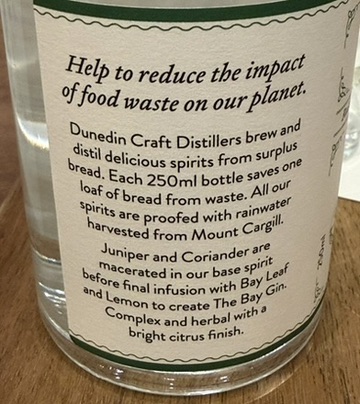
The products are making their mark on Dunedin’s foodie scene. Image Rose Kelly
Success created another problem. Making alcohol from bread is difficult to scale.
Bread mash is thick, awkward and labour intensive, and the pair's early production involved hours of physical stirring. As demand grew, they needed a much larger purpose-built mash kettle to process greater quantities of rescued bakery goods.
So, they turned to their community.
In 2024, Dunedin Craft Distillers launched a crowdfunding campaign with a NZ$25,000 target to commission the new equipment. Supporters pledged more than NZ$27,000. The upgrade meant a process that had previously taken three days could be completed in one.
It's an appropriately grassroots chapter in the story of a business that has never behaved much like a conventional spirits company. McDonald and Stockwell weren't career distillers searching for a clever point of difference in an increasingly crowded gin market. They were trying to solve a waste problem.
By June 2024, the business had already diverted 10 tonnes of bread and bakery products from landfill. And perhaps that is what makes Dunedin Craft Distillers interesting beyond the bottles themselves.
Luxury is increasingly being asked to justify its footprint. Provenance, craftsmanship and rarity still matter, but so does intelligence: where something came from, what resources were consumed to create it, and what happens to what is left behind. In Dunedin, that thinking has produced an unlikely new equation.
Starch becomes sugar. Sugar becomes alcohol. Waste becomes something worth savouring.
And somewhere inside an oak cask, yesterday's bread is slowly becoming tomorrow's whisky.
Related Stories
Editorial
Inside Haiver Spirits long road to the top
By Max Reynolds
26 August 2026
Matthew Anastassiou is far from your average distiller. With stints as a bartender, chemical engineer and air traffic controller, Anastassiou has taken the long way getting to where he is today - founder of award-winning Haiver Spirits.
Editorial
Elegance, expression and attention to detail: A sommelier shares his top Australian wines of the year
By Kaya Martin
22 August 2026
Australians are spoilt for choice when it comes to world-class wines. Though many casual drinkers rarely look beyond our spicy shirazes or toasted chardonnays, real aficionados know just how vast our offerings can be.

Editorial
Curators of the Obscure: How Wild Legs Turned a Small Wine List Into Brisbane’s Biggest Draw
By Lexie Mamo
29 July 2026
Twenty metres off the coast of Western Australia, Shiraz is ageing in a concrete egg on the ocean’s floor. Gently rolled by the tide, the temperature plays its part in ageing this wine, producing an entirely unique result. If this Subsea Estate wine process is news to you, that’s no surprise. However, it’s just another day in the life for Silvana Calil and Manolo Lopez, curators of the obscure in the wine world.